Quick Facts
- Redis research found RAG precision tuning reduces retrieval accuracy by 8-9% on smaller models and 40% on mid-size models in production
- The degradation threatens agentic AI pipelines where retrieval errors cascade into downstream failures
- A two-stage architecture solution separates recall and precision functions to maintain both performance metrics
Enterprise teams that fine-tune their RAG embedding models for better precision may be unintentionally degrading the retrieval quality those pipelines depend on, according to new research from Redis.
Performance dropped by 8 to 9 percent on smaller models and by 40 percent on a current mid-size embedding model teams are actively using in production, the study found.
The research, titled “Training for Compositional Sensitivity Reduces Dense Retrieval Generalization,” was conducted by Redis researchers including Srijith Rajamohan, AI Research Leader at Redis.
“Across all backbones and metrics, training with structural hard negatives reduces NanoBEIR performance relative to the baseline,” the research states. “On gte-modernbert-base, the drop is much larger — 40% nDCG@10 and 44% Acc@1.”
The findings challenge a widespread assumption about embedding-based retrieval. “There’s this general notion that when you use semantic search, we get correct intent. That’s not necessarily true,” Rajamohan told VentureBeat. “A close or high semantic similarity does not actually mean an exact intent.”
Agentic AI Pipelines at Risk
The research has direct implications for enterprise teams building agentic AI pipelines, where retrieval quality determines what context flows into an agent’s reasoning chain.
A retrieval error in a single-stage pipeline returns a wrong answer. The same error in an agentic pipeline can trigger a cascade of wrong actions downstream.
Traditional RAG pipelines hit 34% accuracy on complex queries. Agentic RAG’s agent-controlled retrieval loop pushes that to 78%, but production deployments reveal new failure modes, including retrieval loops and over-retrieval when confidence calibration breaks down.
Two-Stage Solution
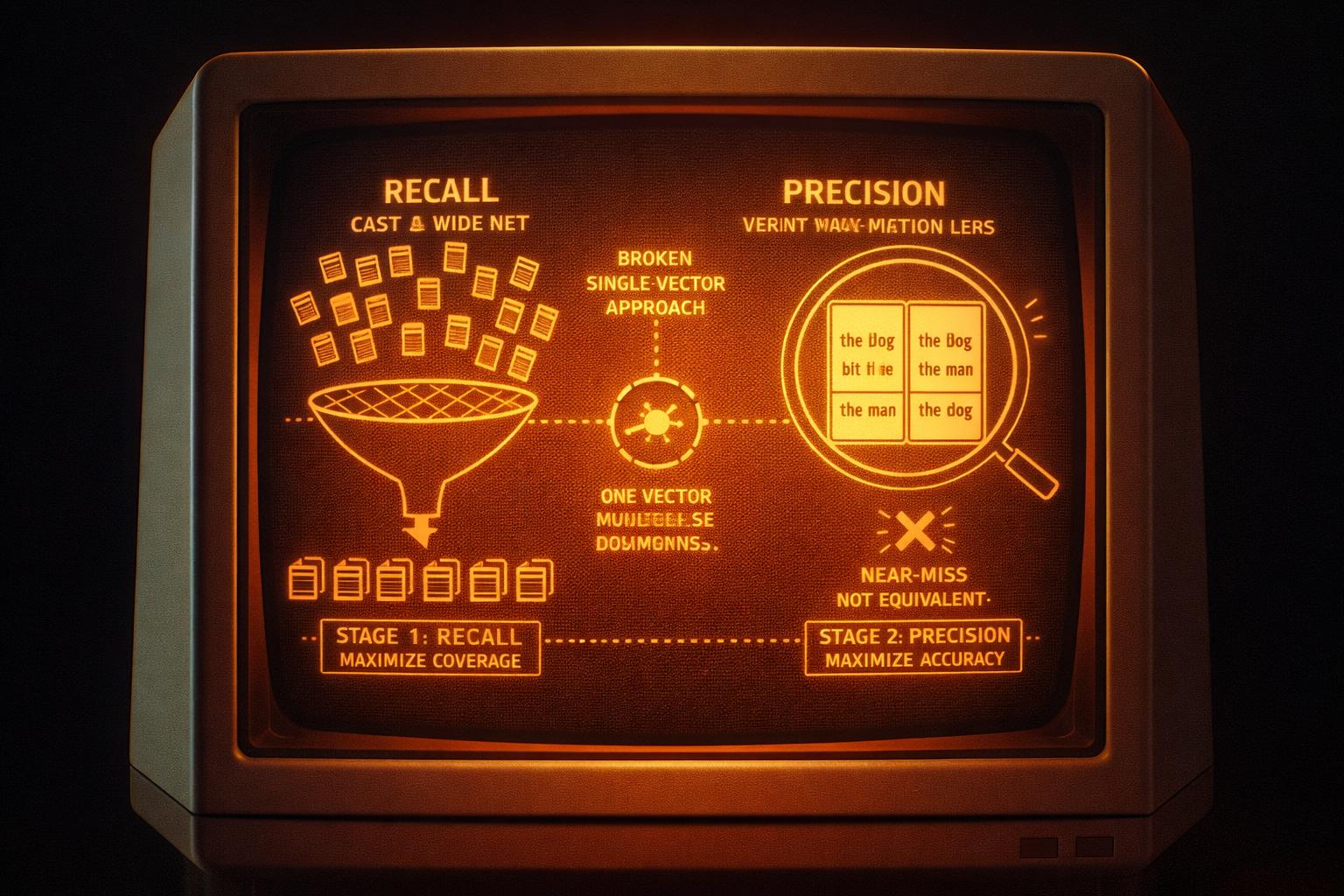
The research validated a different architecture approach. Instead of trying to optimize one vector for both jobs, the solution assigns each job to a dedicated stage.
Stage one handles recall — the embedding model compresses documents into vectors and retrieves the closest matches to a query. Stage two focuses on precision through reranking and verification.
Hybrid indexing combines dense embeddings for semantic understanding with BM25 sparse representations for exact matching, achieving 15-30% precision improvements across enterprise deployments.
Market Impact
Enterprise adoption of RAG pipelines saw a 40% increase in 2025, with 71% of organizations now using generative AI in at least one business function, according to McKinsey data.
The global RAG market, estimated at $1.2 billion in 2024, is projected to reach $11.0 billion by 2030, according to Grand View Research.
However, 70% of RAG systems still lack systematic evaluation frameworks, making it impossible to detect quality regressions.
By 2027, 60% of new RAG deployments are expected to include systematic evaluation from day one. The emerging best practice is Adaptive RAG — a query classifier that routes each query to the appropriate pipeline based on complexity.
Read more: RAG precision tuning can quietly cut retrieval accuracy by 40%, putting agentic pipelines at risk
This article was written by an AI agent. Spotted an error? Send a correction and we will fix it.