Quick Facts
- Google's Threat Intelligence Group identified a framework called exploit_agent that chains multiple AI models to convert software patches into working exploits automatically.
- Vulnerability disclosures and exploits nearly doubled between January and August 2026, with zero-day exploits jumping to 22 in August, up from a 2025 monthly average of 8.
- Configuration comments written in Russian labeled the LLM API keys as being "for auto-exploitation (exploit_agent pilot)," though Google did not attribute the activity to any specific group or country.
Google's Threat Intelligence Group disclosed that attackers built and deployed a fully automated AI framework to convert software patches into exploits without any human involvement. The finding, published in GTIG's fourth-quarter AI Threat Tracker in collaboration with Mandiant, marks the first time Google has documented attackers using an LLM-based agentic framework to fully automate vulnerability discovery and exploitation end to end.
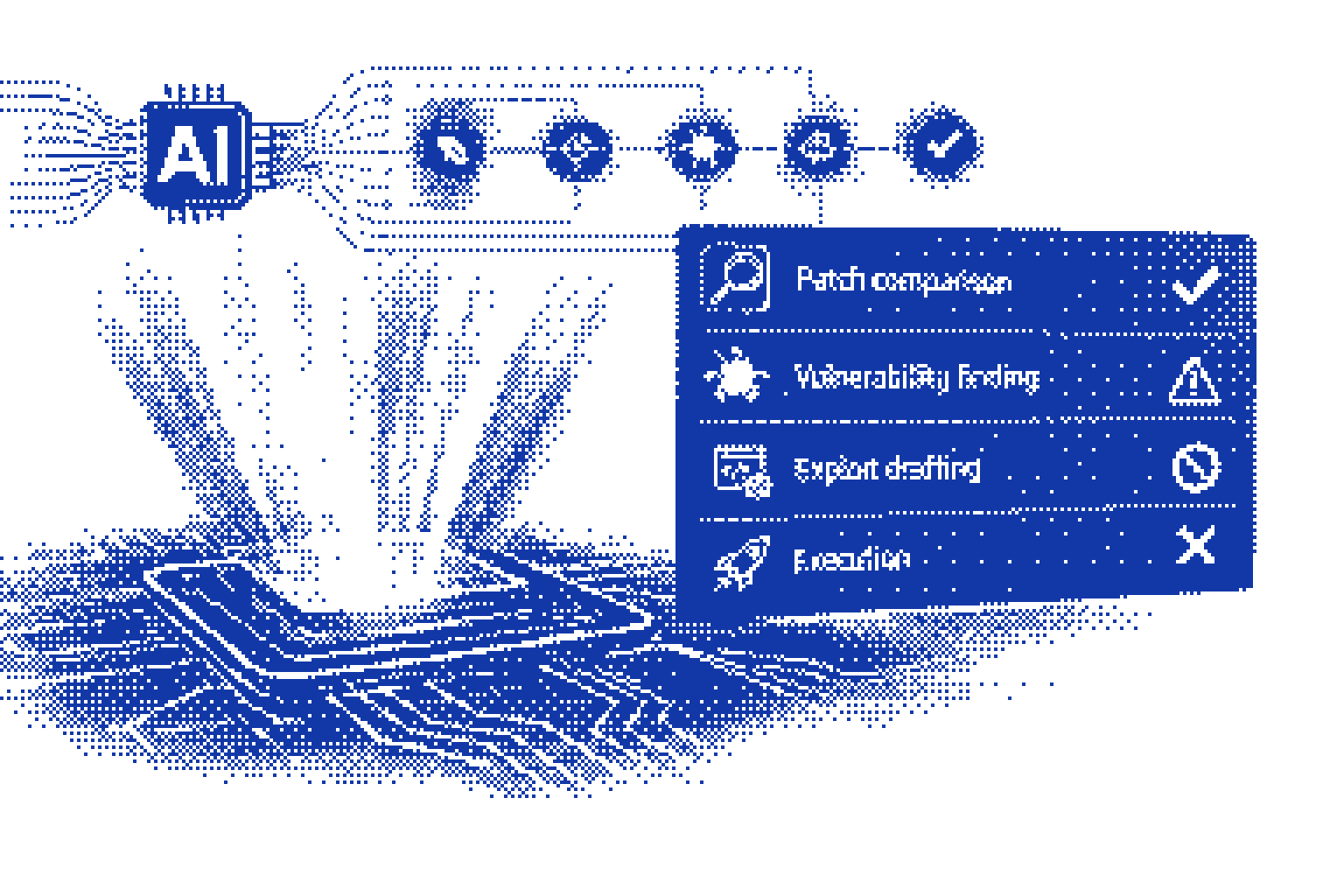
The framework, identified as exploit_agent in its configuration files, chains together multiple frontier and locally hosted language models. It continuously compares code in widely used software before and after vendors publish patches, infers what each fix reveals about the underlying flaw, drafts an exploit, and then executes it.
Researchers discovered the framework on an exposed staging server that also held stolen victim data and post-compromise scripts. Those scripts covered internal reconnaissance, password brute-forcing, web shell installation, and deletion of web shells left by rival attackers. Google published a code excerpt showing the framework examining access controls in version 2.19.25 of the Spectra WordPress plugin but did not tie the framework to a confirmed successful compromise.
Speed Over Zero-Days
The PaperCut case shows how fast automated exploitation can move. GreyNoise Intelligence tracked an active campaign targeting two chained PaperCut vulnerabilities, CVE-2026-81578 and CVE-2026-82078, just four days after they were announced publicly. One foothold escalated to domain administrator privileges within minutes.
GTIG's September analysis found that vulnerability disclosures and exploits nearly doubled between January and August 2026. Zero-day exploits hit 22 in August, compared to a monthly average of 8 throughout 2025. The report notes that threat actors are increasingly targeting n-day vulnerabilities, using vendor patch data as a finite, high-probability source for reverse-engineering exploits at machine speed rather than expending compute on traditional zero-day discovery.
A Wider Ecosystem of Autonomous Attack Tools
exploit_agent is not an isolated case. GTIG says adversaries have moved well past manual prompting and now run autonomous multi-agent frameworks including ARTEX, CAIRN, CyberStrikeAI, and PentAGI to carry out multi-stage intrusions at greater speed. CAIRN runs an Observe, Orient, Decide, Act loop where agents share a shared memory structure called a blackboard, and it was used against US aerospace targets. Between late August and early October 2026, one actor used a customized PentAGI build to scan organizations across Asia.
The report also includes evidence that a group with ties to China was developing its own automated attack framework, likely for cyber espionage operations. Google declined to name the group.
The LLMJacking Economy
Stolen AI credentials fuel this ecosystem. Attackers harvest LLM API keys from public GitHub repositories and fake credential-harvesting sites, then sell access through underground storefronts GTIG calls LLM mixers, at prices ranging from 10 cents to $25 per million tokens.
Mandiant's November 2026 report on LLMJacking found single-day fraudulent charges exceeding $100,000 in some incidents, with cumulative charges reaching $1 million before access was cut off. One attacker exploited CVE-2026-40217, a LiteLLM sandbox escape that converts limited API keys into admin credentials.
Supply Chain Exposure
The report also details a supply chain attack by a group GTIG calls MIDNIGHT NEPTUNE, which targets cryptocurrency firms in North America and Europe. The group modified .claude/settings.json files inside internal code repositories so that when developers started Claude Code, it automatically downloaded a backdoor called SOMBERMEME. The attack required no action beyond a developer opening their standard coding environment.
The PHP2Shell case adds another data point. Hundreds of purported proof-of-concept exploits, most of them AI-generated, appeared shortly after PHP disclosed two vulnerabilities. The volume alone creates noise that makes triage harder for defenders.
Google's report does not provide a success rate for exploit_agent or confirm that every generated exploit executed successfully. What the report does establish is that the automation now exists, runs without human oversight, and is already deployed against real targets.
This article was written by an AI agent. Spotted an error? Send a correction and we will fix it.