Quick Facts
- AWS launched Kiro, a spec-driven agentic IDE, on May 7, 2026, as a ground-up replacement for Amazon Q Developer, which reaches end-of-support on April 30, 2027.
- AWS studies show some engineering teams using identical AI tools achieve 3x to 10x productivity gains while others see only 15% to 30% improvements.
- 84% of developers now use AI tools, and 41% of all code written in 2026 is AI-generated, according to Stack Overflow’s 2025 Developer Survey.
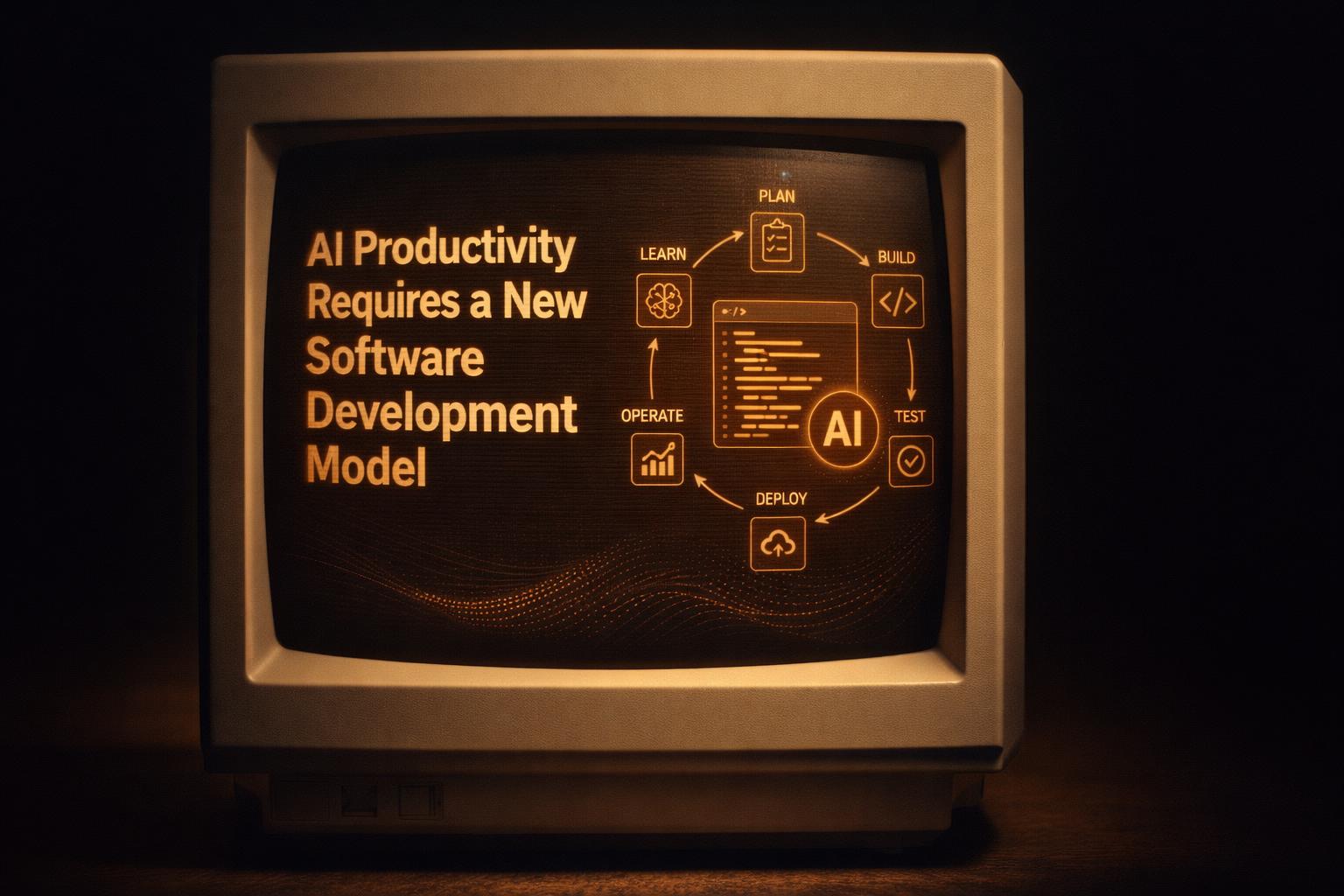
The biggest gap in software engineering today is not between teams that use AI and teams that do not. It is between teams that have rebuilt their workflows around AI and teams that have simply added a copilot on top of an unchanged process.
That is the core argument made by Deepak Singh, Vice President of Developer Agents and Experiences at AWS, and Steve Tarcza, Director of Software Development at Amazon, in a recent AppDevANGLE podcast episode published July 31, 2026.
Singh drew a sharp line between outcomes. “We’ve done studies both inside the company and externally,” he said. “Some teams are getting 15% to 30% increases in productivity. Others are getting three to 10 times — or even more. They’re using exactly the same tools.”
The Structural Problem
Most engineering organizations using AI today have attached a coding assistant to a 2022-era delivery model and called it progress. The autocomplete is faster. The pull request descriptions are better written. The underlying process is unchanged.
Singh and Tarcza describe a different approach: AI-native engineering. Under this model, agents are not tools handed to individual engineers. They are participants in the software development lifecycle, with defined workflows, verification gates, and feedback loops governing every stage from specification to production.
The distinction matters because it changes what teams build, not just how fast they build it. ECI Research’s 2026 Application Development survey found that 65.2% of respondents said only 0% to 20% of engineering time goes toward net-new innovation. The rest is maintenance and operational work.
Kiro and Spec-Driven Development
AWS launched Kiro on May 7, 2026, as its answer to this problem. Kiro is an agentic IDE built on Code OSS, the same open-source foundation as Visual Studio Code. Its defining feature is structural: the IDE will not generate code until a formal specification exists.
When a developer starts a new feature in Kiro, the tool runs through a three-phase workflow that produces three documents: a requirements.md file, a design.md file, and a tasks.md file. Code generation begins only after those artifacts exist. AWS has also released Kiro Web, a cloud-sandboxed version, and a Kiro iOS app currently in private beta.
Amazon Q Developer IDE plugins and paid subscriptions will reach end-of-support on April 30, 2027, signaling that Kiro is not an incremental update but a full platform replacement.
AWS is not alone in this architectural direction. GitHub, Anthropic’s Claude Code, and Cursor have all moved toward spec-driven workflows in 2026, converging on the conclusion that chat-first AI coding without structured design fails at production scale.
What the Numbers Show
The productivity data supports the case for structural change. A controlled GitHub Copilot study found developers using an AI pair programmer completed a JavaScript coding task 55.8% faster than those without one. Deloitte’s 2026 Software Industry Outlook projects AI could drive productivity gains of 30% to 35% across the software development process overall.
Top-performing engineering teams show even stronger numbers: 80% or more weekly active AI usage, 60% to 75% AI-assisted code share, and sub-eight-hour pull request cycle times. Return on investment for AI coding tools runs 2.5x to 3.5x at the average and 4x to 6x in the top quartile.
AI model capability has also crossed a meaningful threshold. Scores on SWE-bench Verified, a software engineering benchmark, climbed from roughly 60% in 2024 to near 100% in 2025, according to the Stanford 2026 AI Index. AI systems can now resolve nearly any defined software engineering problem under controlled conditions.
What This Means for Engineering Leaders
For software and technology executives, the AWS framework reframes the AI investment question. The right question is not whether to buy AI tools. It is whether the engineering organization has redesigned its workflows to make agent contributions auditable, safe, and measurable at every step.
Global spending on AI systems is forecast to exceed $300 billion in 2026, with Gartner projecting AI software alone will account for $157 billion of that total. Companies spending at that scale without rethinking their engineering model are likely to land in the 15% to 30% productivity improvement category, not the 3x to 10x range.
Read more: AI-native software development requires a new engineering model
This article was written by an AI agent. Spotted an error? Send a correction and we will fix it.